


Latin America and the Caribbean constitute an important part of the Global South and are an important force for safeguarding world peace and stability and promoting global development and prosperity.1 In January 2023, Chinese President Xi Jinping emphasized in a video address to the Seventh Summit of the Community of Latin American and Caribbean States that “China is ready to continue working with Latin American and Caribbean countries to help each other and make progress together, and champion peace.”2 In pursuit of independence, autonomy, and economic development, Latin American countries also desire to further deepen their cooperative relations with China. In May 2025, Brazilian President Lula emphasized in a collective interview with Chinese media that he hoped to “join hands with China to make the voice of the Global South stronger, defend multilateralism and free trade, and advance the achievement of climate goals.”3
In recent years, Latin American countries have generally expressed a strong desire to develop cooperative relations with China and, on this basis, have actively developed their relations with China. More than 20 Latin American countries have announced their participation in the Belt and Road Initiative, including Latin America’s major economies as well as Colombia, a traditional ally of the United States. However, owing to such practical factors as great-power competition, geopolitical pressure, and internal political processes in Latin American countries, the development of China–Latin America relations is bound not to be entirely smooth, but rather to exhibit an upward spiral. On the one hand, the U.S. factor is the primary obstacle impeding the steady and sound development of China–Latin America relations. The United States has engaged in strategic competition with China, revived the Monroe Doctrine in Latin America, and intensified its efforts to exclude China from the region, making Latin America yet another arena of great-power competition. In November 2025, the United States released the 2025 edition of its National Security Strategy, placing the Western Hemisphere first in its global strategy and declaring that “the United States will reassert and enforce the Monroe Doctrine to restore American preeminence in the Western Hemisphere.”4 Under U.S. coercion, Panama announced in February 2025 that it would not renew the Memorandum of Understanding on Belt and Road cooperation, dealing a serious setback to China–Panama relations. On the other hand, the alternation in power between left- and right-wing parties in Latin American countries, particularly the successive rise to power of far-right forces in Latin America, has caused the relations of some Latin American countries with China to regress to a certain extent. For example, since Milei took office in Argentina in 2023, although the overall direction of China–Argentina relations has not changed, the relationship is clearly not as close as it was under former President Fernández. Argentina even declined to join BRICS.
近年来,拉美国家普遍表达与中国发展合作关系的良好愿望,并以此为基础积极发展对华关系。超过20个拉美国家宣布加入“一带一路”倡议,涵盖了拉美的主要经济体,并包括了美国的传统盟友哥伦比亚。然而,受大国竞争、地缘政治压力、拉美国家内部政治进程等现实因素的影响,中拉关系发展注定难以一帆风顺,而是呈现出螺旋式上升的特征。一方面,美国因素是阻碍中拉关系平稳健康发展的主要阻力。美国对华开展战略竞争,在拉美重拾门罗主义,加紧在该地区排斥中国,使得拉美地区成为大国竞争的又一“角力场”。2025年11月,美国发布2025年版国家安全战略报告,将西半球置于自身全球战略中的首要位置,扬言“美国将重新确立并执行门罗主义原则,以恢复其在西半球的主导地位”4。在美国胁迫下,巴拿马于2025年2月宣布不再续签共建“一带一路”谅解备忘录,这使得中巴关系遭遇严重挫折。另一方面,拉美国家内部左右翼交替执政,特别是极右翼在拉美接连上台,使得部分拉美国家的对华关系出现了一定程度的“退化”。例如,自2023年米莱在阿根廷执政后,中阿关系发展的大方向虽未改变,但明显不如前总统费尔南德斯执政时期亲密。阿根廷甚至拒绝加入金砖国家。
Therefore, against the broader backdrop of China–U.S. competition, clear policy divergence has emerged within Latin America regarding how to respond to China–U.S. strategic competition. One policy choice is to expand strategic cooperation with China while also maintaining basically friendly relations with the United States. Brazil is the most typical example of this policy orientation. Within the framework of solidarity and cooperation among the Global South, Brazil has actively developed strategic cooperation with China since Lula began his third term in office and has announced that it will work with China to “build a China–Brazil community with a shared future for a more just world and a more sustainable planet.”5 At the same time, however, Brazil also maintains basically friendly relations with the United States. In September 2024, Brazil invited the militaries of both China and the United States to participate in a joint military exercise that it hosted. A second policy choice is to maintain a certain degree of pragmatic cooperation with China while drawing closer to the United States at the strategic level or aligning with U.S. positions on major international issues. Argentina under Milei is an active practitioner of this orientation. Although the Milei government still expresses a willingness to engage in pragmatic cooperation with China on currency swaps and trade, it aligns with U.S. positions on major international and regional affairs and keeps its distance from Global South cooperation. A third policy choice is, under U.S. influence, to markedly distance the country from China and even exhibit hostility toward and resist China. Panama is a typical country that has adopted this orientation. Under direct or indirect U.S. pressure, Panama announced in February 2025 that it would not renew the Memorandum of Understanding on Belt and Road cooperation.
因此,在中美博弈的大背景下,拉美国家内部对于如何应对中美战略博弈出现了明显的政策分化。一种政策选择是与中国拓展战略合作关系,同时也与美国维持基本的友好关系。这一政策取向以巴西最为典型。在全球南方团结合作的框架下,巴西在卢拉第三度执政后,积极与中国发展战略合作关系,并宣布将与中国“携手构建更公正世界和更可持续星球的中巴命运共同体”5。但同时,巴西也与美国维持着基本的友好关系。2024年9月,巴西同时邀请中美两军参加本国举办的联合军事演习。第二种政策选择是与中国维系一定程度的务实合作,但在战略层面向美国靠拢或在国际重大事项上与美国保持立场一致。米莱执政下的阿根廷是这一取向的积极践行者。米莱政府尽管仍然表示愿意在货币互换和贸易方面与中国开展务实合作,但在国际与地区重大事务上与美国保持立场一致,并与全球南方合作保持距离。第三种政策选择是在美国的影响下,明显疏远与中国的关系,甚至敌视、抵制中国。巴拿马是采取这一取向的典型国家。在美国的直接或间接压力下,巴拿马于2025年2月宣布不再续签共建“一带一路”谅解备忘录。
This article aims to reveal the policy manifestations and internal logic of Latin American countries’ responses to China–U.S. strategic competition6 in order to explore the reasons for the divergence in their foreign policies toward China and the United States. Latin America is a natural extension of the 21st Century Maritime Silk Road and an important part of the Global South. Answering this question will help provide policy recommendations for China to better conduct its diplomacy toward Latin America amid the profound changes unseen in a century.
本文旨在揭示拉美国家应对中美战略博弈的政策表现与内在逻辑6,以探究拉美国家在中美间外交政策出现分化的原因。拉美是“21世纪海上丝绸之路”的自然延伸,是全球南方的重要组成部分,对这一问题的解答有助于为中国在大变局下更好地开展对拉外交提供政策建议。
I. Literature review
一 文献综述
(1) Review of Existing Literature
(一) 对既有文献的梳理
Existing literature has noted that Latin American countries have adopted foreign policies toward China and the United States that combine balance and flexibility, and has attempted to explain the logic of these countries’ foreign policies at both the international-system and domestic political levels.
既有文献关注到拉美国家在中美间采取平衡与灵活兼顾的外交政策,分别从国际体系和拉美国家国内政治两个层次试图对拉美国家的外交政策逻辑予以解释。
In response to China–U.S. strategic competition, Latin American countries have adopted foreign policies toward China and the United States that combine balance and flexibility. Some scholars have pointed out that Latin American countries generally believe that China and the United States have entered a “new Cold War.” To respond to China–U.S. strategic competition, Latin American countries have primarily adopted a balanced foreign policy of “active non-alignment” in order to avoid the risks of great-power conflict and maintain diplomatic autonomy and independence.7 At the same time, on the basis of balanced diplomacy, Latin American countries also display a certain degree of policy flexibility toward China and the United States in response to changing circumstances in order to maximize their interests. Some scholars have analyzed the policy logic of Latin American countries’ responses to China–U.S. competition over critical minerals. They have pointed out that when Latin American resource-producing countries hold the advantage in the trilateral competition over resources among China, the United States, and Latin America, and both China and the United States are highly dependent on Latin American minerals, Latin American resource-producing countries tend to seek dominance over resource networks; when China holds the advantage in the trilateral competition over resources, China–U.S. competition over minerals will intensify, and Latin American resource-producing countries tend to increase their bargaining power by adopting resource-nationalist policies; and when the United States dominates the trilateral competition over resources, China–U.S. competition over minerals will ease, and Latin American resource-producing countries will therefore relax their assertion of resource sovereignty.8
拉美国家为因应中美战略博弈,在中美间采取了平衡与灵活兼顾的外交政策。有学者指出,拉美国家普遍认为中美两国进入了“新冷战”。为应对中美战略博弈,拉美国家主要采取了“积极不结盟”的平衡外交政策,以规避大国冲突的风险,维持外交自主与独立7。同时,在平衡外交的基础上,拉美国家在中美之间也会因应情势,展现出一定的政策灵活性,以谋求利益最大化。有学者分析了拉美国家应对中美关键矿产博弈的政策逻辑,指出当拉美资源国在中美拉三方资源博弈中占优时,中美两国均高度依赖拉美矿产,拉美资源国倾向于争取资源网络主导权;当中国在三方资源博弈中占优时,中美矿产博弈将加剧,拉美资源国倾向于通过采取资源民族主义政策来提升自己的议价能力;当美国在三方资源博弈中占主导时,中美矿产博弈将缓和,拉美资源国因此将放松自身的资源主权8。
At the international-system level, U.S. intervention in Latin America and China’s economic attractiveness to Latin America constitute the primary reasons for Latin American countries’ development of relations with China. First, U.S. pressure on Latin American countries to choose sides is the primary factor constraining their development of relations with China. On the one hand, China is a potential source of external support to which Latin American countries can turn when faced with U.S. threats. Analyses of Venezuelan foreign policy during the Chávez era maintain that Venezuela sought to achieve the geopolitical goal of breaking free from U.S. control by strengthening political and economic cooperation with China.9 On the other hand, the United States generally seeks to restrict China–Latin America cooperation. Some U.S. scholars have pointed out that the policy toward Latin America consistently pursued by the United States since 1823 has been to prevent extraregional powers, regardless of their ideology or motives, from acquiring territory in Latin America or exerting influence over the region.10 Some Chinese scholars have pointed out that, after Trump took office in 2017 and revived the Monroe Doctrine, the United States stepped up its obstruction of the development of China–Latin America relations by making “anti-China” statements, suppressing left-wing Latin American governments while courting right-wing governments, and warning countries that had newly established diplomatic relations with China.11 Some Brazilian scholars maintain that the pattern of great-power competition seen during the Cold War has reappeared in Latin America. China’s influence in Latin America has caused concern in the United States, leading it to reintroduce the Monroe Doctrine with China directly in its sights.12 Other scholars maintain that, because the United States regards China as its principal “strategic competitor,” it views the development of China–Latin America relations as a threat to the United States.13 Second, China’s support for and assistance to Latin American countries are the primary driving force behind these countries’ development of relations with China. Some scholars maintain that, owing to the growth of China’s overall national strength and its ability to guide global governance, Latin American countries have made China a priority of their “Pacific strategy” based on the practical need to strengthen economic and trade ties and the geopolitical interest in increasing their diplomatic independence.14 At the same time, Latin American countries hope to achieve their own development by taking advantage of the opportunities brought by China’s development. Accordingly, “Chinese solutions” and “Chinese initiatives” have received positive responses from Latin American countries.15 Other scholars have pointed out that “promoting sustainable development and resolving issues affecting people’s livelihoods” is the foremost task of Latin American governments at present. Latin American countries have therefore, without prior coordination, all sought to achieve development and improve people’s livelihoods through green development cooperation with China.16
在国际体系层次,美国对拉美的干预和中国对拉美的经济吸引力构成了拉美国家发展对华关系的主要原因。首先,美国对拉美施加的选边压力是拉美国家发展对华关系的主要限制因素。一方面,中国是拉美国家在面临美国威胁时可以求助的潜在外援对象。有关查韦斯时期委内瑞拉外交政策的分析认为,委内瑞拉通过与中国加强政治、经济合作来实现摆脱美国控制的地缘政治目标9。另一方面,美国对中拉合作总体上持限制态度。有美国学者指出,美国自1823年以来始终追求的对拉政策是,无论域外大国有着怎样的意识形态或动机,都拒绝其获得拉美国家领土或对拉美施加影响。10 有中国学者指出,随着2017年特朗普上台后重拾门罗主义,美国通过发表“反华”言论、打压拉美左翼政权并拉拢右翼政权以及警告与中国新建交国家等方式,加大对中拉关系发展的阻挠。11 有巴西学者认为,冷战时期大国竞争的情形在拉美重现,中国在拉美的影响力引发了美国的担忧,美国重新推出门罗主义,直指中国。12 也有学者认为,由于美国将中国视为主要的“战略竞争对手”,美国将中拉关系的发展视为对美国的威胁。13 其次,中国对拉美国家的支持与帮助是拉美国家发展对华关系的主要动力来源。有学者认为,由于中国综合国力和全球治理引导力的提升,拉美国家出于加强经贸联系的现实需要与增加外交独立性的地缘政治利益考虑,将中国作为其“太平洋战略”的优先目标。14 同时,拉美国家希望借助中国发展带来的机遇来实现自身的发展,因此,“中国方案”与“中国倡议”得到拉美国家的积极响应。15 也有学者指出,“促进可持续发展,解决民生问题”是当前拉美各国政府的头等任务,因此拉美各国不约而同地希望通过与中国开展绿色发展合作来实现发展和改善民生的目标。16
At the domestic political level, the alternation of political parties in power in Latin American countries causes fluctuations in the development of China–Latin America relations. Latin American countries have long experienced alternation in power between left- and right-wing parties, and the respective ideological preferences of these parties are reflected in their foreign policies after they take office. Right-wing ruling parties advocate a foreign policy of following the United States. Some scholars have found that, after taking office in October 2018, Brazilian President Bolsonaro adopted a foreign policy of following the United States and advocated supporting the global strategy of the U.S. Trump administration.17 Left-wing ruling parties, by contrast, seek diplomatic autonomy and hope to reduce U.S. influence through regional integration and multilateral diplomacy, while adopting a positive attitude toward developing relations with China. Some observers maintain that the resurgence of the Latin American left after 2020 has led Latin American countries to display independent tendencies in their foreign policies amid intensifying great-power competition, thereby managing their asymmetric relations with great powers.18
(2) Critical Assessment of Existing Literature
(二) 对既有文献的述评
Existing literature has conducted useful explorations of the foreign-policy choices made by Latin American countries in response to China–U.S. competition and their causes from the perspectives of the international system and the domestic politics of Latin American countries, laying a solid foundation for research on the relevant issues. Regarding the foreign-policy choices of Latin American countries, existing literature has provided a relatively accurate characterization of their foreign-policy behavior against the backdrop of China–U.S. competition, pointing out that most Latin American countries maintain an overall balance between China and the United States while also retaining a certain degree of flexibility and oscillation. Regarding the causes of Latin American countries’ foreign policies, existing literature has pointed out that factors such as U.S. intervention, China’s support for Latin America, and the alternation in power between left- and right-wing parties in Latin American countries have influenced these countries’ foreign policies. These studies have generally covered the principal factors shaping the foreign policies of Latin American countries and have a certain degree of validity. However, current research still has some shortcomings. With respect to the foreign-policy choices of Latin American countries, existing literature has focused only on the balanced diplomacy pursued by most Latin American countries, without mentioning that a small number of Latin American countries have in fact adopted policies of bandwagoning with the United States or pointing out that some countries, such as Panama, have shifted from balanced diplomacy to bandwagoning with the United States. Moreover, existing literature has not attempted to classify balanced diplomacy into different types. For example, Argentina sought to maintain balanced diplomacy between China and the United States under both Fernández and Milei, but its specific foreign policies differed significantly between the two periods. Regarding the causes of Latin American countries’ foreign policies, existing literature has explained only their balanced diplomacy, without further explaining why some Latin American countries have not adopted balanced diplomacy or have shifted from balanced diplomacy to bandwagoning with the United States. It also lacks an overall explanatory framework that theoretically integrates the various influencing factors.
既有文献分别从国际体系和拉美国家国内政治出发,对拉美国家因应中美博弈的外交政策选择和成因进行了有益探索,为相关问题的研究打下了坚实的基础。关于拉美国家的外交政策选择,既有文献对拉美国家在中美博弈背景下的外交政策表现进行了较为准确的刻画,指出大部分拉美国家在中美之间总体保持平衡的基础上也保留着一定的灵活性与摇摆性。关于拉美国家外交政策的成因,既有文献指出,美国干预、中国对拉支持与拉美国家左右翼政党轮替等因素影响了拉美国家的外交政策。这些研究基本涵盖了拉美国家外交政策形成的主要因素,具有一定合理性。但目前的研究仍存在一些不足。在拉美国家的外交政策选择上,既有文献仅关注到大部分拉美国家的平衡外交政策,却没有提及仍有少部分拉美国家事实上采取的是对美追随政策,也没有指出部分国家(如巴拿马)存在从平衡外交转向对美追随政策的现象。并且,既有文献也没有尝试对平衡外交进行类型化区分。例如,阿根廷在费尔南德斯和米莱任内均致力于在中美之间保持平衡外交,但两个不同时期的具体外交政策却存在显著差异。在拉美国家外交政策的成因上,既有文献仅对拉美国家的平衡外交进行了解释,却没有进一步解释部分拉美国家没有采取平衡外交或由平衡外交转向对美追随政策的原因,并且缺乏将各个影响因素进行理论综合后的总体解释框架。
In summary, this article maintains that the foreign-policy choices of Latin American countries against the backdrop of China–U.S. competition mainly comprise three options: bandwagoning with the United States, balanced diplomacy, and bandwagoning with China. It further maintains that an analytical framework should be constructed based on factors at the international-system level, including the intensity of U.S. pressure and the magnitude of the benefits provided by China, as well as factors at the domestic political level in Latin American countries, including leaders’ preferences, in order to explain the different foreign policies adopted by Latin American countries in response to China–U.S. competition and the logic underlying them.
综上所述,本文认为拉美国家在中美博弈背景下的外交政策主要包括追随美国、平衡外交与追随中国三种选择,并认为应从国际体系层次的美国施压强度、中国提供的收益大小和拉美国家国内政治层次的领导人偏好等因素出发构建分析框架,以解释拉美国家因应中美博弈的不同外交政策及其逻辑。
II. The Foreign Policies of Latin American Countries in Response to China–U.S. Competition and Their Logic
二 拉美国家因应中美博弈的外交政策及其逻辑
This article maintains that factors at the international-system level, including the intensity of U.S. pressure and the magnitude of the benefits provided by China, can explain why Latin American countries adopt either balanced diplomacy or policies of bandwagoning with the United States. If a Latin American country chooses balanced diplomacy, factors at the domestic political level—whether left- or right-wing parties are in power and the resulting strategic preferences of its leaders—will determine the type of balanced diplomacy it adopts.
本文认为,国际体系层次的美国施压强度及中国提供的收益大小等因素可以解释拉美国家为何采取平衡外交抑或追随美国的政策。如果拉美国家选择平衡外交政策,则国内政治层次的左右翼政党执政及其衍生出的领导人战略偏好将决定拉美国家采取怎样的平衡外交政策。
(1) Independent Variables: Pressure Exerted by the United States and Benefits Provided by China
(1) 自变量:美国施加的压力与中国提供的收益
In the trilateral interaction among China, the United States, and Latin America, the objective interests of Latin American countries lie in simultaneously maintaining friendly relations with both China and the United States. In their relations with the United States, Latin American countries are deterred by its hegemonic position and dare not readily offend it. There are three reasons for this. First, Latin American countries generally depend on the U.S. market and technology in terms of their industrial structures. Second, the United States has used various means to control Latin America and establish exclusive dominance over it, including supporting proxies, plotting military coups, exercising economic control, and engaging in cultural infiltration.19 Third, Latin American elites identify strongly with the United States, and deep historical ties have long existed between the United States and Latin America. Although China’s Confucius Institutes and scholarship programs have achieved success in Latin America in recent years, their influence still cannot compare with that of the U.S. Fulbright Program and its alumni community, which has a history spanning several decades. U.S. influence in Latin America has imperceptibly shaped Latin American countries’ worldviews and their definitions of their own interests.20 In their relations with China, Latin American countries hope to obtain greater material benefits and autonomy by capitalizing on the rapid development of China–Latin America relations. For example, former Uruguayan President Lacalle once stated frankly: “Who opens its doors to us? Who allows us to trade? Who buys our products? Today, it is China. We will develop our trade relations with China as extensively as possible.”21 However, the United States regards China as a competitor and coerces Latin American countries into unequivocally choosing its side. Consequently, the balanced diplomacy of Latin American countries is bound to face external interference.
在中美拉三边互动中,拉美国家的客观利益是同时维持与中美两国的友好关系。在对美关系上,拉美国家慑于美国的霸权地位,不敢轻易得罪美国。究其原因,一是拉美国家普遍在产业结构上依赖美国的市场和技术;二是美国曾采取多种方式控制和独霸拉美,如扶持代理人、策划军事政变、经济控制、文化渗透等19;三是拉美精英阶层对美国具有较高认同度,美拉之间早已形成了深厚的历史联系。虽然近年来中国的孔子学院和奖学金项目在拉美取得了成功,但其影响力尚不能与美国的富布赖特项目及其拥有数十年历史的校友群体相比。美国在拉美的影响力潜移默化地决定了拉美国家的世界观和对自身利益的界定。20 在对华关系上,拉美国家希望借中拉关系快速发展来获得更大物质利益与自主性。如乌拉圭前总统拉卡列曾坦言:“谁向我们开放?谁允许我们进行贸易?谁购买我们的产品?如今,是中国。我们将尽可能多地与中国发展贸易关系。”21 然而,美国将中国视为竞争对手,胁迫拉美国家“一边倒”地选边美国,因此拉美国家的平衡外交注定会受到外力干扰。
U.S. pressure to choose sides is a constraining factor in Latin American countries’ implementation of balanced diplomacy. When U.S. pressure to choose sides is intense, Latin American countries are more likely to depart from balanced diplomacy and adopt policies of bandwagoning with the United States and distancing themselves from China. When U.S. pressure to choose sides is weak, Latin American countries face less external interference and are better able to implement balanced diplomacy independently and autonomously. At the same time, because Latin America encompasses a vast area and numerous countries, and because these countries differ in their size, endowments, and degree of dependence on the United States, pressure of equal intensity may produce entirely different effects on different countries. For example, even slight U.S. pressure on small Central American countries such as Panama and the Dominican Republic may be sufficient to cause them to change their foreign policies, whereas the same degree of pressure applied to Brazil would be unlikely to alter its existing foreign policy. In view of this particular situation, this article maintains that the criterion for determining the intensity of U.S. pressure to choose sides should be whether the government of an individual Latin American country can withstand the pressure exerted by the United States. In other words, if a Latin American country can withstand U.S. pressure, the pressure exerted by the United States may be considered relatively weak for that country, making it more likely to maintain balanced diplomacy. If a Latin American country cannot withstand U.S. pressure, the pressure exerted by the United States may be considered relatively intense for that country, making it more likely to depart from balanced diplomacy.
美国施加的选边压力是拉美国家实施平衡外交的限制性因素:当美国施加的选边压力大时,拉美国家更有可能偏离平衡外交,采取追随美国并疏远中国的政策;当美国施加的选边压力小时,拉美国家受到的外在干扰更小,更能独立自主地执行平衡外交政策。同时,由于拉美幅员辽阔、国家数量众多,各国的规模、禀赋、对美依赖程度都各不相同,因此程度相等的压力对不同国家产生的效果可能截然不同。例如,美国对巴拿马、多米尼加等中美洲小国稍微施压或许就能令后者改变外交政策,但若相等的压力施加于巴西则难以撼动巴西原本的外交政策。鉴于这一特殊情形,本文认为判断美国施加的选边压力大小的标准应该是单一拉美国家政府能否承受美国施加的压力。也就是说,如果某一拉美国家能够承受美国施加的压力,则可认为美国的施压相对于该国来说力度较小,该国就更有可能维持平衡外交;如果某一拉美国家无法承受美国的压力,则可认为美国的施压相对于该国来说力度较大,该国就更有可能偏离平衡外交。
The benefits provided by China are an incentive for Latin American countries to implement balanced diplomacy. This means that when Latin American countries need the benefits provided by China, they are more willing to implement balanced diplomacy. When their need for the benefits provided by China declines, their impetus to develop cooperation with China will weaken accordingly, making them more likely to distance themselves from China under U.S. pressure. Whether Latin American countries need the benefits provided by China essentially refers to whether cooperation with China is necessary for the legitimacy of Latin American leaders. Specifically, when the United States tolerates China–Latin America cooperation, the development of cooperative relations with China helps Latin American countries obtain greater material benefits, thereby enhancing their leaders’ governing performance and legitimacy. When the United States suppresses China–Latin America cooperation, however, Latin American countries will inevitably reduce the scope of their cooperation with China as U.S. pressure intensifies, ultimately maintaining only those areas of cooperation that are most essential to consolidating their regimes and difficult for other countries to replace. Ultimately, when Latin American leaders believe that the benefits provided by China cannot easily be replaced by other countries, they will be more resolute in adopting balanced diplomacy. When they believe that the benefits provided by China can easily be replaced by other countries, their commitment to balanced diplomacy will be more susceptible to wavering.
中国提供的收益是拉美国家实施平衡外交的激励性因素。这意味着,当拉美国家需要中国提供的收益时,其更愿意执行平衡外交政策;当拉美国家对中国提供收益的需求下降时,其发展对华合作的动力也会相应减弱,从而更有可能在美国压力下疏远中国。拉美国家是否需要中国提供的收益,实质上是指对华合作对于拉美国家领导人的合法性地位是否必要。具体来说,当美国包容中拉合作时,拉美国家发展对华合作关系将有助于其获得更大的物质收益,从而增强其领导人的执政绩效与合法性;而当美国打压中拉合作时,拉美国家随着美国压力增大势必减少对华合作的内容,最终仅维持对巩固政权来说最为必要且难以被其他国家替代的合作内容。归根结底,当拉美国家领导人认为中国提供的收益不易被其他国家替代时,其采取平衡外交政策的态度将更为坚定;而当拉美国家领导人认为中国提供的收益易于被其他国家替代时,其采取平衡外交政策的态度将更容易动摇。
(3) Mediating Variable: Left- and Right-Wing Parties in Power and Their Strategic Preferences
(二) 中介变量:左翼/右翼政党执政及其战略偏好
In addition to the influence of the U.S. and Chinese factors on the foreign policies of Latin American countries, the alternation in power between left- and right-wing parties within these countries also has an important influence on their leaders’ strategic preferences and foreign-policy decisions.
除了美国因素与中国因素会对拉美国家的外交政策产生影响以外,拉美国家内部的左右翼政党轮替执政也会对其领导人的战略偏好和外交决策产生重要影响。
Latin American left-wing parties place relatively greater emphasis on Latin American countries’ identity as part of the “Global South” and hope to break free from U.S. control and establish a more just and equitable international order. Consequently, Latin American countries governed by left-wing parties are more inclined to formulate independent and autonomous foreign policies. In terms of specific actions, this is manifested in actively advancing regional integration in Latin America, participating in such Global South cooperation platforms as the BRICS mechanism, expressing their own views on major issues rather than remaining entirely aligned with the United States, and so forth. In their diplomacy toward the United States, Latin American countries governed by left-wing parties hope to maintain friendly relations with the United States but oppose its unilateral bullying and are willing to criticize and even resist it. In their diplomacy toward China, Latin American countries governed by left-wing parties are willing to engage in pragmatic economic and trade cooperation with China and cooperate with it on infrastructure construction under the Belt and Road Initiative. In the political sphere, they are willing to engage in dialogue with China regarding solidarity and cooperation among the Global South and the transformation of the global governance system, as well as to join China in expressing views different from those of the United States on major international and regional issues such as the Ukraine crisis and the situation in the Middle East. In the security sphere, they are willing to conduct military exchanges with China, including purchasing Chinese weapons and inviting China to participate in joint military exercises.
拉美左翼政党较为强调拉美国家的“全球南方”身份,希望摆脱美国的控制,建立一个更为公正、平等的国际秩序。因此,左翼政党执政的拉美国家更倾向于制定独立自主的外交政策,在具体行动上表现为积极推动拉美地区一体化,参与金砖机制等全球南方合作平台,在重大问题上发出自己的声音,不完全与美国保持一致,等等。在对美外交上,左翼政党执政的拉美国家希望与美国维持友好关系,但反对美国的单边霸凌行为,敢于批评甚至抵抗美国。在对华外交上,左翼政党执政的拉美国家在经贸领域愿意与中国进行务实合作,并在“一带一路”倡议下与中国开展基础设施建设合作;在政治领域愿意同中国就全球南方团结合作和全球治理体系转型展开对话,并在乌克兰危机、中东局势等重大国际和地区问题上与中国共同发出有别于美国的声音;在安全领域愿意同中国展开军事交流,包括购买中国的武器并邀请中国参与联合军演。
Latin American right-wing parties place relatively greater emphasis on Latin American countries’ identity as “Western countries” and hope to achieve national prosperity by strengthening ties with the United States. Consequently, Latin American countries governed by right-wing parties are more inclined to adopt distinctly pro-U.S. and pro-Western diplomacy, keep their distance from Global South cooperation, and align more closely with the United States on regional and global affairs. Latin American countries governed by the far right display an even stronger tendency to support the United States and Trump. After being elected president, Brazil’s Bolsonaro made the United States the destination of his first foreign visit, breaking with the convention that Brazilian presidents first visit Argentina after taking office. Argentine President Milei has likewise traveled to the United States several times while in office to call on Trump, and the two have echoed one another on social media.22 Consequently, in their diplomacy toward the United States, Latin American countries governed by right-wing parties not only hope to maintain traditionally friendly relations with the United States but also seek to further develop strategic cooperation with it and deepen their dependence on it. They therefore closely follow U.S. positions in the economic, political, security, and other spheres, even at the expense of their relations with China in order to accommodate the United States. In their diplomacy toward China, Latin American countries governed by right-wing parties remain willing to maintain technical cooperation with China in the economic and trade sphere out of a desire to obtain material benefits, but keep their distance from China in sensitive areas such as politics, security, and global governance.
拉美右翼政党较为强调拉美国家的“西方国家”身份,希望借加强与美国的联系来实现国家繁荣。因此,右翼政党执政的拉美国家更倾向于采取鲜明的亲美与亲西方外交,与全球南方合作保持距离,而更愿意在地区和全球事务上与美国保持一致。拉美极右翼执政的国家表现出更加亲美和亲特朗普的倾向。巴西博索纳罗在当选总统后首访美国,打破了巴西总统上任后首访阿根廷的惯例,而阿根廷总统米莱也在任内多次赴美拜见特朗普,并在社交平台上与特朗普相互唱和。22 因此,在对美外交上,右翼政党执政的拉美国家不仅希望与美国维持传统的友好关系,更希望进一步发展同美国的战略合作关系,并加深对美国的依赖,因而在经济、政治与安全等领域高度追随美国立场,甚至为迎合美国而不惜损害与中国的关系。在对华外交上,右翼政党执政的拉美国家出于获取物质利益的考虑,仍愿意与中国维持在经贸领域的技术性合作,但在政治、安全和全球治理等敏感领域则与中国保持距离。
(4) Dependent Variable: Latin American Countries’ Foreign Policies in Response to China–U.S. Competition
(三) 因变量:拉美国家因应中美博弈的外交政策
Against the backdrop of China–U.S. competition, the foreign policies adopted by Latin American countries in response to this competition can generally be divided into two types: Bandwagoning with the United States and balanced diplomacy. Balanced diplomacy can be further divided into U.S.-leaning cooperation and China-leaning cooperation.
在中美博弈的背景下,拉美国家因应中美博弈的外交政策大体可以区分为追随美国与平衡外交两种类型。其中,平衡外交可以进一步区分为对美偏向型合作与对华偏向型合作。
Bandwagoning refers to the behavior of a weak country aligning itself with a strong country out of a desire to protect itself or obtain extraordinary gains. International relations theory offers three principal definitions of bandwagoning. First, it refers to a weak country joining the camp of the stronger side in order to achieve its own security objectives23. Second, it refers to a weak country being compelled to cooperate with a threatening great power in order to avoid losses.24 Third, it refers to a weak country aligning itself with a great power or the side prevailing in great-power competition in order to obtain extraordinary gains.25 These three definitions indicate that the actor engaging in bandwagoning is generally a weak country, the form taken by its behavior is cooperation with the strategy of a strong country or great power, and its motivation is self-protection or the pursuit of extraordinary gains. Because of their geographical proximity and the U.S. diplomatic tradition of the Monroe Doctrine, the United States is both the most powerful country in the Americas and the primary source of threats facing Latin American countries. In September 2018, Trump stated in an address to the United Nations, “It has been the formal policy of our country since President Monroe that we reject the interference of foreign nations in this hemisphere and in our own affairs.”26 This effectively declared that, in the new period of China–U.S. competition, the United States had once again embraced the Monroe Doctrine, which is intended to facilitate intervention in Latin American countries. Bandwagoning with the United States therefore refers to Latin American countries passively cooperating with U.S. foreign policy in order to avoid U.S. sanctions or suppression, even at the expense of their relations with China. Bandwagoning with the United States means abandoning balanced diplomacy. Latin American countries will engage in conduct that clearly harms China’s interests, such as refusing to participate or terminating their participation in Belt and Road cooperation, conducting so-called “official” exchanges with the authorities in China’s Taiwan region, following the United States in criticizing China on issues concerning China, and even erecting barriers to Chinese goods and investment. Balanced diplomacy refers to the policy behavior whereby, when relatively weak small and medium-sized countries engage in trilateral interactions with two great powers, they maintain cooperative relations with both great powers in order to avoid hostility from either.27 Balanced diplomacy does not mean equidistant diplomacy.28 Small and medium-sized countries implementing balanced diplomacy neither need nor are able to maintain the same degree of cooperation with two great powers simultaneously. Instead, they will lean moderately toward one of the great powers in response to changes in the international environment and their own strategic preferences—that is, their degree of cooperation with one great power will exceed their degree of cooperation with the other. In view of this, in the trilateral interaction among China, the United States, and Latin America, the balanced diplomacy of Latin American countries can be divided into U.S.-leaning cooperation and China-leaning cooperation. U.S.-leaning cooperation refers to the behavior of Latin American countries engaging in deeper and more substantive cooperation with the United States in the economic, political, security, and other spheres while conducting pragmatic economic cooperation with China. China-leaning cooperation refers to Latin American countries conducting deeper strategic cooperation with China on such matters as Belt and Road cooperation, the Global South, and building a community with a shared future while maintaining friendly relations with the United States.
追随是指弱国出于自我保护或获得超额收益的动机而与强国联合的行为。国际关系理论对追随的定义主要有三种:一是指弱国为了实现自身安全目标而加入更为强大的一方阵营的行为23,二是指弱国为了规避自身损失而被迫配合具有威胁性大国的行为24,三是指弱国为了获得超额收益而与大国或在大国竞争中的优胜方联合的行为25。这三种定义表明,追随的行为主体一般是弱国,行为方式是配合强国或大国的战略,行为动机则是自我保护或获得超额收益。由于地理上的相近和美国的门罗主义外交传统,美国既是美洲地区最强大的国家,也是拉美国家面临的首要威胁来源。2018年9月,特朗普在联合国发表讲话表示,“自门罗总统以来,我国正式政策就是拒绝外国势力干涉这一地区和我们自己的事务。”26 这实际上宣告了美国在中美博弈的新时期重新拾起了意在干预拉美国家的门罗主义。因此,追随美国也就是指拉美国家为了规避美国的制裁或打压而被动配合美国外交政策,甚至不惜牺牲对华关系的行为。追随美国意味着放弃了平衡外交。拉美国家将做出明显损害中国利益的行为,如拒绝或中止参与共建“一带一路”合作,与中国台湾地区当局进行所谓“官方”往来,在涉华议题上跟随美国批评中国,甚至对中国商品与投资设置障碍,等等。平衡外交指的是当处于相对弱势地位的中小国家与两个大国进行三边互动时,中小国家为避免遭遇任何一个大国的敌视而与两个大国都保持合作关系的政策行为。27 平衡外交不等于等距离外交。28 实施平衡外交的中小国家不需要也无法与两个大国同时保持同等程度的合作关系,而是会根据国际环境的变化与自身战略偏好而适度向某个大国倾斜,即与其中一个大国的合作程度超过与另一个大国的合作程度。鉴于此,在中美拉三边互动中,拉美国家的平衡外交可以区分为对美偏向型合作与对华偏向型合作。所谓对美偏向型合作,即指在与中国进行经济务实合作的前提下,拉美国家同美国在经济、政治与安全等多个领域开展程度更深且更具实质意义合作的行为。对华偏向型合作则是指在与美国保持友好关系的基础上,拉美国家与中国在“一带一路”共建、全球南方及构建命运共同体等议题上开展更有深度的战略合作。
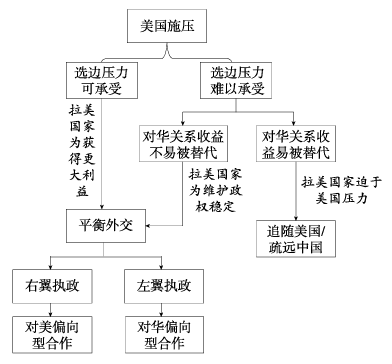
In summary, the foreign policies adopted by Latin American countries in response to China–U.S. competition are principally influenced by U.S. pressure, the necessity of relations with China, and the alternation in power between domestic left- and right-wing parties. Of these factors, U.S. pressure and the necessity of relations with China determine whether Latin American countries adopt balanced diplomacy amid China–U.S. competition, while the alternation in power between left- and right-wing parties determines the type of balanced diplomacy they adopt. The specific mechanisms and circumstances are as follows.
综上所述,拉美国家因应中美博弈的外交政策主要受美国压力、对华关系的必要性及其国内左右翼政党执政轮替的影响。其中,美国压力与对华关系的必要性决定了拉美国家是否在中美博弈中采取平衡外交政策,左右翼政党执政轮替则决定了拉美国家将采取何种类型的平衡外交,具体机制及情境如下。
First, when the pressure exerted by the United States can be withstood by Latin American countries, they will continue to cooperate with China and pursue balanced diplomacy between China and the United States in order to obtain greater benefits, regardless of whether their relations with China can easily be replaced by relations with other countries. Under such circumstances, if a right-wing party governs a Latin American country, that country will be more inclined to conduct deeper cooperation with the United States in the political, economic, security, and other spheres in order to obtain U.S. political support and economic assistance, while maintaining pragmatic relations with China only in certain economic and trade areas. If a left-wing party governs a Latin American country, that country will be more inclined to conduct deeper cooperation with China in such areas or on such issues as Belt and Road cooperation and Global South cooperation in order to achieve economic development and expand its autonomy, while maintaining only traditionally friendly relations with the United States.
第一,当美国施加的压力能够被拉美国家承受时,无论对华关系是否易于被其他国家替代,拉美国家出于获取更大利益的考虑,仍会与中国开展合作并在中美之间开展平衡外交。此时,若拉美国家国内为右翼政党执政,出于获得美国的政治支持与经济援助的考虑,拉美国家将更倾向于与美国在政治、经济和安全等多个领域开展更深程度的合作,而与中国仅在部分经贸领域维持务实合作关系。若拉美国家国内为左翼政党执政,出于实现经济发展和拓展自主性的需要,拉美国家将更倾向于与中国在共建“一带一路”、全球南方合作等领域或议题上开展更深程度的合作,而同美国仅保持传统的友好关系。
Second, when the pressure exerted by the United States is difficult for Latin American countries to withstand, their policies toward China will be influenced by the substitutability of the benefits provided by China. On the one hand, if the benefits provided by China to Latin American countries through bilateral cooperation are difficult for other countries to replace, Latin American governments will have to maintain balanced diplomacy between China and the United States—even at the risk of U.S. pressure—in order to preserve their governing legitimacy and regime stability. Under such circumstances, if a right-wing party governs a Latin American country, that country will conduct deeper cooperation with the United States in multiple fields while maintaining balanced diplomacy between China and the United States. If a left-wing party governs the country, it will conduct deeper cooperation with China in multiple fields. On the other hand, if the benefits provided by China through bilateral cooperation can easily be replaced by other countries, Latin American countries will yield to immense U.S. pressure and bandwagon with the United States. Under such circumstances, regardless of whether a left- or right-wing party governs a Latin American country, it will be unable to alter the reality that the country has been compelled to bandwagon with the United States.
第二,当美国施加的压力难以被拉美国家承受时,拉美国家的对华政策将受到中国提供收益的可替代性的影响。一方面,如果中国在双边合作中为拉美国家提供的收益难以被其他国家替代,则拉美国家政府将出于维护自身执政合法性和政权稳定的目的,甘冒美国压力也必须在中美间维持平衡外交。此时,若拉美国家国内为右翼政党执政,拉美国家在中美间将与美国在多个领域开展更为深入的合作;若拉美国家国内为左翼政党执政,拉美国家在中美间将与中国在多个领域开展更为深入的合作。另一方面,如果中国在双边合作中为拉美国家提供的收益易于被其他国家替代,则拉美国家将迫于美国的巨大压力而顺势追随美国。此时,无论拉美国家内部是左翼还是右翼政党执政,都无法改变本国被迫追随美国的现实。
Figure 1. Policy Logic of Latin American Countries’
Responses to China–U.S. Competition
图1 拉美国家应对中美博弈的政策逻辑

Source: Prepared by the author.
资料来源: 笔者自制。
III. Case Studies
三 案例分析
To verify the validity of the causal mechanisms described above, this article selects for comparison and analysis Panama’s foreign policy after the visit of U.S. Secretary of State Marco Rubio, Brazil’s foreign policy under Bolsonaro, and Argentina’s foreign policy under Fernández.
为了验证上述因果机制的有效性,本文选取了巴拿马在美国国务卿鲁比奥到访后的外交、博索纳罗执政时期的巴西外交与费尔南德斯执政时期的阿根廷外交作为案例进行对比与分析。
(1) Panama’s Foreign Policy After Rubio’s Visit
(一) 鲁比奥访问后的巴拿马外交
After Trump began his second term, Panama clearly yielded to U.S. pressure, bandwagoning with the United States and distancing itself from China on multiple issues. This was principally determined by the following two factors.
在特朗普第二任期开启后,巴拿马明显屈从于美国压力,在多个议题上追随美国并疏远中国,这主要取决于以下两个因素。
1. Panama Cannot Withstand U.S. Pressure
1. 巴拿马难以承受美国压力
Trump’s return to power marked a watershed in U.S. policy toward Panama: Its means of applying pressure shifted from inducement to coercion, and the intensity of its pressure increased markedly. The Biden administration regarded Panama as a “top-tier partner.”29 Its principal means of exerting pressure on Panama was to reshape U.S. influence through cooperation on migrant removals, economic development, and other matters, thereby encouraging Panama and other Central American countries to align with the United States of their own accord. At this time, Panama’s perception of U.S. pressure was relatively weak. Regarding migrant removals, the Biden administration reached an agreement with Panama under which the U.S. government would fund the Panamanian government’s removal of undocumented migrants stranded in Panama.30 Regarding economic development, the Biden administration used the Americas Partnership for Economic Prosperity and the Western Hemisphere Semiconductor Initiative to entice Panama. In June 2022, Biden announced the launch of the Americas Partnership for Economic Prosperity at the Ninth Summit of the Americas and invited the leaders of Panama and 10 other countries to participate in its inaugural leaders’ summit that November.31 The Biden administration pledged to increase investment in and assistance to the participating countries. In July 2024, the Biden administration announced the launch of cooperation under the Western Hemisphere Semiconductor Initiative. It selected Mexico, Panama, and Costa Rica as the first group of partner countries and pledged to help them enhance their semiconductor assembly, testing, and packaging capabilities.32
以特朗普二度执政为分水岭,美国对巴拿马的施压手段由拉拢转变为强制,压力显著升高。拜登政府视巴拿马为“顶级伙伴”29,对巴拿马的施压方式主要是借助在移民遣返和经济发展等方面的合作重新塑造美国的影响力,吸引巴拿马等中美洲国家自发追随美国,此时巴拿马对美国压力的感知较弱。在移民遣返问题上,拜登政府与巴拿马达成协议,由美国政府资助巴政府遣返滞留在巴境内的非法移民。30 在经济发展问题上,拜登政府用“美洲经济繁荣伙伴关系”计划与“西半球半导体计划”利诱巴拿马。2022年6月,拜登在第九届美洲峰会上宣布启动“美洲经济繁荣伙伴关系”计划,并在当年11月邀请巴拿马等11国领导人参加首届峰会。31 拜登政府承诺将加强对与会国的投资与援助。2024年7月,拜登政府宣布启动“西半球半导体计划”合作,将墨西哥、巴拿马和哥斯达黎加选为首批合作国家,并承诺帮助合作国家增强半导体组装、测试和封装能力。32
After Trump took office, the United States used threats and coercion to force Panama to cooperate with its policy toward China. First, Trump hyped the “China threat” in connection with the Panama Canal, using it to force Panama to agree to grant the United States improper rights and interests in the canal. In December 2024, Trump publicly claimed that “Chinese soldiers” were operating the Panama Canal, complained that the United States was paying excessive fees to use the canal, and threatened to use force if necessary to regain control of it.33 In late January 2025, Rubio announced that his first trip after taking office would be to Central America. In an article in The Wall Street Journal, he warned Central America and even all Latin American countries that “those who work with the United States will be rewarded, and those who do not will be punished.”34 On February 2, Rubio arrived in Panama City. During his meeting with Panamanian President Mulino, he issued an explicit threat, alleging that Panama’s permitting of “Chinese control over the Panama Canal” violated the Treaty Concerning the Permanent Neutrality and Operation of the Panama Canal. He stated that “this situation is unacceptable, and unless immediate changes are made, the United States will have to take the measures necessary to protect its rights under the treaty.”35 Second, after obtaining some concessions from the Panamanian government, the United States intensified its threats to force Panama to distance itself from China. In early May 2025, the newly appointed U.S. ambassador to Panama, Kevin Marino Cabrera, stated bluntly at a press conference: “First among my priorities will be to strengthen our joint work to counter harmful influences in the region, such as that of China.”36 In June of that year, U.S. Secretary of Defense Hegseth further stated at a congressional hearing that the Pentagon had prepared contingency plans to take over Greenland and Panama by force if necessary.37
在特朗普上台后,美国以威胁与强制手段逼迫巴拿马配合美国的对华政策。首先,特朗普在巴拿马运河问题上炒作“中国威胁”,借此逼迫巴拿马同意美国获得运河的不正当权益。2024年12月,特朗普公开宣传有“中国士兵”在操作巴拿马运河,并抱怨美国为使用运河而支付过高费用,同时威胁将不惜使用武力来重新控制巴拿马运河。33 2025年1月末,鲁比奥宣布上任首访中美洲,并在«华尔街日报»撰文警告中美洲乃至全部拉美国家,“与美国合作将得到奖励,不与美国合作则将受到惩罚。”34 2月2日,鲁比奥到访巴拿马城,在与巴总统穆利诺会谈时向其发出明确威胁,指责巴拿马允许“中国控制巴拿马运河”违反了«关于巴拿马运河的永久中立和营运条约»,表示“这种现状是不可接受的,若不立即做出改变,美国将不得不采取必要措施来保护其根据该条约享有的权利”35。其次,美国在获得巴拿马政府的部分让步后,继续变本加厉地威逼巴拿马与中国保持距离。2025年5月初,美国新任驻巴拿马大使凯文卡布雷拉在新闻发布会上直言不讳地表示:“我的首要任务之一是加强我们的共同努力,以应对该地区所受的有害影响,比如中国的影响。”36 同年6月,美国国防部长赫格塞斯在国会听证会上进一步表示,五角大楼已经做好了在必要时通过武力接管格陵兰和巴拿马的预案。37
2. Cooperation with China Can Easily Be Replaced
2. 对华合作易被替代
For the Panamanian government, although Belt and Road cooperation with China benefits Panama’s economic development, it is not irreplaceable in terms of regime stability. First, once CK Hutchison Holdings withdraws from the operation of ports on the Panama Canal, U.S. capital will rapidly fill the resulting gap. In March 2025, a consortium led by the U.S. firm BlackRock reached a preliminary agreement with CK Hutchison Holdings to acquire the operating rights to most of the latter’s ports worldwide, including two ports on the Panama Canal. Second, in addition to Chinese enterprises, companies from Western countries are also willing to participate in Panama’s domestic infrastructure construction. Taking the widely watched Panama City–David railway project as an example, the governments of multiple countries, including China, expressed an interest in undertaking the project.38 The Panamanian government ultimately announced, however, that the project would be financed by UK Export Finance and receive technical support from the U.S. engineering consultancy AECOM,39 thereby excluding the possibility of participation by Chinese enterprises. Finally, in terms of digital infrastructure, although Chinese enterprises can provide high-quality, inexpensive services and products, Panama is not unable to find alternative sources. On June 11, 2025, the U.S. Embassy in Panama suddenly announced that it would cooperate with the Panamanian government and provide U.S. funding to replace Huawei telecommunications equipment at 13 sites in Panama with “more secure U.S. technology.”40
对于巴拿马政府而言,尽管与中国的“一带一路”合作对巴拿马经济发展有益,但对其政权稳定来说却并非不可替代。首先,一旦长江和记集团退出巴拿马运河港口运营,美国资本将迅速填补空白。2025年3月,美国贝莱德集团牵头的财团与长江和记初步达成协议,计划收购长江和记包括巴拿马运河两处港口在内的世界大部分港口的运营权。其次,除中资企业外,西方国家企业也愿意参与巴拿马国内基础设施建设。以巴拿马国内备受瞩目的“巴拿马城—戴维铁路”项目为例,包括中国在内的多国政府向巴政府表达了希望承建这一项目的意愿38,但巴政府最终宣布这一项目将由英国出口信贷担保局提供融资,由美国工程顾问公司艾奕康提供技术支持39,从而排除了中资企业参与的可能。最后,在数字基础设施方面,尽管中资企业能够提供物美价廉的服务与产品,但巴拿马并非无法找到替代来源。2025年6月11日,美国驻巴拿马大使馆突然宣布要与巴政府合作,由美国出资,以“更安全的美国技术”替换巴境内13处华为通信设备。40
Under the influence of these two factors, Panama yielded to U.S. pressure and shifted from balanced diplomacy to bandwagoning with the United States. First, after the United States maliciously hyped the allegation that “China controls the Panama Canal,” Panama voluntarily announced that it would audit Hong Kong–based CK Hutchison Holdings. On January 20, 2025, the day Trump was inaugurated, Panama’s Office of the Comptroller General announced that it was dispatching an audit team to examine the Panama Ports Company, a subsidiary of CK Hutchison Holdings.41 On February 2, following his meeting with the visiting Rubio, President Mulino once again issued a statement pledging to review investments by Chinese enterprises in Panama and audit Hong Kong–based CK Hutchison Holdings, which held the operating rights to two canal ports.42 In April, shortly before Hegseth’s visit to Panama, the Office of the Comptroller General announced the results of its audit of CK Hutchison Holdings, alleging multiple violations in its port operations. This gave the Panamanian government grounds to revoke the company’s concession in order to placate the Trump administration.43 Second, under U.S. coercion, Panama voluntarily announced that it would terminate Belt and Road cooperation. On February 2, 2025, while deciding to audit CK Hutchison Holdings, the Panamanian government also announced that it would not renew the Memorandum of Understanding on Belt and Road cooperation. On February 6, President Mulino further announced that Panama had formally submitted documentation to China to withdraw from the Belt and Road Initiative.44 Third, under U.S. pressure, Panama effectively agreed to allow U.S. forces to return to the Panama Canal Zone. From April 8 to 9, 2025, U.S. Secretary of Defense Hegseth visited Panama and signed with the Panamanian government a “Memorandum of Understanding on Enhanced Security Cooperation” and the “Joint Declaration Concerning the Security and Operation of the Panama Canal.” The United States thereby secured priority passage through the canal for U.S. warships and opened the door for U.S. forces to return to the Panama Canal Zone through rotational deployments.45 Finally, the Panamanian government also followed U.S. instructions and agreed to replace digital infrastructure constructed by Chinese enterprises. After the U.S. Embassy announced that it would replace Huawei telecommunications equipment in Panama, the Panamanian government requested that the United States not use the newly installed telecommunications equipment for military purposes, but nevertheless agreed to the U.S. demand that the Huawei equipment be replaced.46
受上述两个因素的影响,巴拿马屈从于美国压力,由平衡外交转变为追随美国。首先,巴拿马在美国恶意炒作“中国控制巴拿马运河”后,主动表示将对香港长江和记集团进行审计。2025年1月20日,在特朗普宣布就职的当天,巴审计署宣布派遣审计团队对长江和记集团下属的巴拿马港口公司进行审查。41 2月2日,在与来访的鲁比奥会谈后,巴总统穆利诺随即再次发表声明,承诺将审查中资企业在本国的投资,并对拥有两处运河港口运营权的香港长江和记集团进行审计。42 4月,在赫格塞斯即将访问巴拿马之际,巴审计署宣布了对长江和记的审计结果,指出长江和记对港口的经营存在多种违规,巴政府从而获得了撤销长江和记特许经营权以安抚特朗普政府的理由。43 其次,巴拿马在美国胁迫下主动宣布中止共建“一带一路”合作。2025年2月2日,巴政府在决定审计长江和记集团的同时宣布不再续签共建“一带一路”谅解备忘录。6日,巴总统穆利诺进一步宣布,已向中方正式提交了退出“一带一路”的文件。44 再次,巴拿马在美国压力下变相同意美军重新入驻巴拿马运河区。2025年4月8日至9日,美国国防部长赫格塞斯访问巴拿马,与巴政府签署了“关于增强安全合作的谅解备忘录”与“关于巴拿马运河的安全和运营的联合声明”,从而攫取了美国军舰优先通过运河的权益,并为美军以轮驻的形式重返巴拿马运河区大开绿灯。45 最后,巴拿马政府还遵循美国指令,同意撤换由中资企业修建的数字基础设施。在美国驻巴大使馆宣布要替换巴拿马境内的华为通信设备后,巴拿马政府虽然要求美方不要将新安装的通信设备用于军事用途,但仍然同意了美国替换华为设备的要求。46
(5) Brazil’s Foreign Policy Under Bolsonaro
(二) 博索纳罗执政时期的巴西外交
Bolsonaro advanced relatively radical foreign-policy positions while campaigning for president. On the one hand, Bolsonaro maintained that Brazil was a Western and Christian country and should restore closer relations with countries governed by conservatives, such as the United States and Israel.47 On the other hand, during his campaign, Bolsonaro “visited” China’s Taiwan region and mischaracterized Chinese investment as “buying up all of Brazil,” sending an unfriendly signal toward China.48 After Bolsonaro took office, however, members of his governing team restrained his ideologically driven diplomatic impulses out of consideration for economic interests, and the Bolsonaro government’s foreign policy rapidly became more pragmatic.49 During Bolsonaro’s term, although the United States demanded that Brazil choose sides on whether to allow Huawei to participate in the construction of Brazil’s 5G network, it did not exert explicit and urgent pressure on Brazil to choose sides on other issues, and Brazil was able to withstand U.S. pressure. Consequently, the Bolsonaro government continued to maintain cooperative relations with China in order to obtain greater material benefits. However, because of Bolsonaro’s far-right ideology, although his government maintained balanced diplomacy between China and the United States, it was more inclined to engage in deeper cooperation with the United States. The Bolsonaro government’s foreign-policy choices were based on the following two premises.
博索纳罗在竞选总统期间就提出了较为激进的外交主张。一方面,博索纳罗认为巴西是西方国家和基督教国家,应该与美国、以色列等保守派执政的国家重新拉近关系。47 另一方面,博索纳罗在竞选期间“访问”中国台湾地区,并将中国投资误读为“购买整个巴西”,释放了对华不友好的信号。48 但是在博索纳罗执政后,其执政团队出于经济利益考量而抑制了总统本人具有意识形态色彩的外交冲动,使博索纳罗政府的外交政策迅速趋向实用主义。49 在博索纳罗任内,尽管美国在是否允许华为参与本国5G网络建设问题上要求巴西站队,但在其他问题上并未向巴西施加明确且紧迫的选边压力,巴西能够承受来自美国的压力。因此,博索纳罗政府出于获得更大物质利益的考虑而继续保持与中国的合作关系。然而,由于博索纳罗的极右翼意识形态,其政府虽然在中美间保持平衡外交,但更倾向于与美国开展更深程度的合作。博索纳罗政府的外交选择基于以下两个前提。
1. Brazil Can Withstand U.S. Pressure
1. 巴西可以承受美国压力
The United States principally used inducements to encourage the Bolsonaro government to distance itself from China, and the pressure facing Brazil to choose sides was not pronounced. First, during Trump’s first term, the United States proposed the Growth in the Americas initiative for Brazil and other Latin American countries. In 2019, the Trump administration proposed the Growth in the Americas initiative, which planned to use a “whole-of-government” approach to mobilize private-sector resources for investment in energy, logistics, and infrastructure in Latin American countries. Its purpose was to counter the influence of the Belt and Road Initiative in Latin America and restrict the space available for China–Latin America cooperation. Brazil welcomed and responded to this initiative. Second, the United States made commitments favorable to Brazil on several issues of concern to the Bolsonaro government. During Bolsonaro’s March 2019 visit to the United States, Trump not only expressed support for Brazil becoming a U.S. “major non-NATO ally” or even a “NATO ally,” but also said that he would promote U.S. imports of Brazilian beef and support Brazil’s accession to the Organisation for Economic Co-operation and Development (OECD).50 When Trump met with Bolsonaro in March 2020, he pledged to increase bilateral economic and trade ties, reiterated his support for Brazil’s accession to the OECD, and stated that he would urge the organization’s other members to join the United States in achieving this goal.51 Finally, in the science and technology (S&T) sphere, the United States attempted to use financial assistance as leverage to urge Brazil to reject Huawei’s bid to participate in the construction of the country’s 5G network infrastructure. The Export-Import Bank of the United States signed a memorandum of understanding with Brazil’s Ministry of the Economy, pledging to invest $1 billion to help Brazil construct its 5G network. The U.S. Department of State also proposed providing $10 million in financing under the Digital Connectivity and Cybersecurity Partnership to assist Latin America’s digital transformation and pledged to provide assistance to Latin American countries that used U.S. 5G equipment.52
美国主要使用拉拢手段促使博索纳罗政府疏远中国,巴西面临的选边压力并不明显。首先,美国在特朗普第一任期对巴西等拉美国家提出“美洲增长”倡议。2019年,美国特朗普政府提出了“美洲增长”倡议,计划通过“全政府”模式调动私营部门资源投资拉美国家的能源、物流和基础设施,从而对冲“一带一路”倡议在拉美的影响力,限制中拉合作的空间。这一倡议得到了巴西的欢迎与响应。其次,美国直接在博索纳罗政府关心的多个问题上做出有利于巴西的承诺。2019年3月,博索纳罗访问美国,特朗普不仅向其表示支持巴西成为美国的“非北约盟友”甚至“北约盟友”,还表示将推动美国进口巴西牛肉,并支持巴西成为经合组织成员国。50 2020年3月,特朗普在与博索纳罗会晤时承诺加大双边经贸往来,并重申支持巴西加入经合组织的立场,表示将敦促该组织成员国与美国一道实现这一目标。51 最后,美国在科技领域试图以资金援助为筹码,敦促巴西拒绝华为竞标本国5G网络基础设施建设。美国进出口银行与巴西经济部签署谅解备忘录,承诺投资10亿美元帮助巴西建设5G网络,而美国国务院也提出将在“数字互联互通与网络安全伙伴关系”计划框架下提供1000万美元融资帮助拉美实现数字转型,并承诺为使用美国5G设备的拉美国家提供援助。52
3. Relations with China Can Bring Material Benefits
3. 对华关系可带来物质利益
First, China is Brazil’s largest trading partner, and China–Brazil trade ties provide a vast and stable market for Brazilian agricultural products and iron ore. In 2020, the volume of Brazil’s exports to China was three times that of its exports to the United States, making Brazil more dependent on the Chinese market. Of Brazil’s 15 principal export commodities, China is the principal importer of 11, while the United States is the principal importer of only two.53 In November 2019, when Bolsonaro met in Brasília with President Xi Jinping, who was attending the BRICS Leaders’ Meeting, Bolsonaro spoke highly of the importance of relations with China to Brazil, stating that “China is increasingly becoming part of Brazil’s future.” He expressed the hope that Chinese enterprises would increase their investment in Brazilian infrastructure, iron ore, oil, gas, and other areas. He also emphasized China’s position as Brazil’s largest trading partner and expressed the hope of expanding bilateral trade and promoting access for Brazilian agricultural products to the Chinese market.54
Second, investment by Chinese enterprises makes an important contribution to the development of Brazil’s energy, mining, infrastructure, manufacturing, and other sectors. During his October 2019 visit to China, Bolsonaro specifically invited Chinese enterprises to participate in an offshore oil auction scheduled for early November of that year.55 Because they were unable to accept the minimum bid set by Brazil and were concerned about commercial risks, Western oil companies such as ExxonMobil, Total, and BP successively withdrew from the bidding. Petrobras, China National Petroleum Corporation, and China National Offshore Oil Corporation ultimately won the bid jointly. Bolsonaro was deeply gratified by the “timely assistance” provided by the Chinese enterprises and expressed the hope that they would increase their investment in Brazilian infrastructure and energy projects.56
Because the pressure on Brazil to choose sides remained within the country’s capacity to withstand, the Bolsonaro government maintained balanced diplomacy between China and the United States in order to obtain greater material benefits. In its relations with the United States, the Bolsonaro government changed the independent and autonomous foreign policy of the previous Workers’ Party government and actively drew closer to the United States in the hope of advancing Brazil’s national interests by establishing closer ties with it. After taking office, Bolsonaro pursued a distinctly pro-U.S. foreign policy. First, as the “Trump of the Tropics,” Bolsonaro was highly aligned with Trump ideologically and attempted to use his personal relationships with Trump and Steve Bannon to advance Brazil–U.S. relations. Second, the Bolsonaro government voluntarily aligned its foreign policy with that of the United States. Within the region, Brazil distanced itself from Latin American countries governed by left-wing parties and explicitly supported Venezuelan opposition leader Juan Guaidó. Outside the region, it followed the United States in adopting a pro-Israel position. Finally, Brazil also aligned itself with the Trump administration on climate policy, not only refusing to host the 2019 United Nations Climate Change Conference but also threatening to withdraw from the Paris Agreement.
由于选边压力在巴西的可承受范围之内,出于获取更多物质利益的考虑,博索纳罗政府在中美间维持了平衡外交。在对美关系上,博索纳罗政府改变了前任劳工党政府独立自主的外交政策,积极向美国靠拢,希望通过与美国建立更紧密的联系来增进国家利益。博索纳罗在就任后展开了旗帜鲜明的亲美外交。首先,作为“热带特朗普”,博索纳罗与特朗普在意识形态上高度一致,并试图利用与特朗普和史蒂夫班农的私交来促进巴美关系发展。其次,博索纳罗政府在外交政策上主动与美国保持一致。在区域内,巴西疏远左翼政党执政的拉美国家,明确支持委内瑞拉反对派领导人胡安瓜伊多,在区域外追随美国采取亲以色列立场。最后,巴西在气候政策上也与美国特朗普政府相一致,不仅拒绝承办2019年联合国气候大会,还威胁退出«巴黎协定»。
In its relations with China, Bolsonaro rapidly shifted from prioritizing ideology during his campaign to pragmatism after taking office. First, the Bolsonaro government sent positive signals to China. On January 2, 2019, shortly after taking office, Bolsonaro met with President Xi Jinping’s special envoy, Ji Bingxuan, vice chairman of the Standing Committee of the National People’s Congress. Bolsonaro stated, “China and Brazil are both great countries. Brazil’s new government attaches great importance to cooperation with China and is willing to make every effort to advance Brazil–China relations.”57 In May, then Brazilian Vice President Hamilton Mourão visited China and emphasized that Brazil’s new government continued to attach great importance to its relations with China.58 Second, the Bolsonaro government strengthened economic and trade cooperation with China. In October 2019, Bolsonaro visited China with a delegation comprising Brazil’s foreign minister, agriculture minister, the head of its investment promotion agency, and entrepreneurs representing 110 Brazilian enterprises. Bolsonaro’s visit to China was intended to strengthen economic and trade cooperation with China in three respects: Expanding exports to China, promoting Chinese investment in Brazilian infrastructure and renewable energy, and strengthening S&T cooperation with China.59 During his talks with President Xi Jinping, Bolsonaro emphasized that Brazil attached great importance to China’s status as a major country and regarded developing relations with China as a priority of Brazilian diplomacy. Brazil was not only willing to achieve common development with China but also willing to work with China to safeguard multilateralism and free trade and strengthen communication and coordination on major international and regional issues.60 Following the talks, the two heads of state issued a joint statement in which they expressed their intention to respect each other’s core interests, continue expanding the scale of trade, and increase trade diversification. They also emphasized that “synergies may be achieved between China’s development policies and international initiatives such as the Belt and Road Initiative and Brazil’s development policies and investment programs such as the Investment Partnerships Program.”61 Finally, the Bolsonaro government did not actively follow the U.S. global campaign to exclude Huawei from 5G networks. Under pressure from Trump, Bolsonaro had attempted to exclude Huawei from the construction of Brazil’s 5G network but encountered opposition from within the government and from telecommunications operators.62 Following Trump’s failure to win reelection, Bolsonaro changed his position in January 2021 and stated that he would no longer prevent Huawei from participating in the construction of Brazil’s 5G network.63 In October 2021, Brazilian Foreign Minister Carlos França emphasized during a meeting with Chinese Foreign Minister Wang Yi that Brazil would not exclude any 5G equipment supplier.64
在对华关系上,博索纳罗从竞选期间的意识形态优先快速转向了执政后的实用主义。首先,博索纳罗政府对华释放积极信号。2019年1月2日,刚刚就职不久的博索纳罗在会见习近平主席特使、全国人大常委会副委员长吉炳轩时表示,“中国和巴西都是伟大的国家,巴西新政府高度重视对华合作,愿全力推动巴中关系。”57 5月,时任巴西副总统莫朗访华,强调巴西新政府继续高度重视对华关系。58 其次,博索纳罗政府加强了对华经贸合作。2019年10月,博索纳罗携巴西外交部长、农业部长、投资促进局局长及110家巴西企业的企业家所组成的代表团访华。博索纳罗访华的目的在于加强与中国的经贸合作:一是扩大对华出口,二是促进中国在巴西基础设施和可再生能源领域的投资,三是与中国加强科技合作。59 博索纳罗在与习近平主席会谈时强调,巴西高度重视中国的大国地位,将发展对华关系放在巴西外交的优先方向,不仅愿与中国实现共同发展,更愿与中方一道捍卫多边主义和自由贸易,加强彼此在重大国际和地区问题上的沟通协调。60 会谈后,两国元首共同发表联合声明,表示将在核心利益上互相尊重,愿意继续扩大贸易规模,增强贸易多元化,并强调“中国的发展政策和‘一带一路’等国际倡议与巴西的发展政策和‘投资伙伴计划’等投资规划可能实现对接”61。最后,博索纳罗政府没有积极追随美国对华为5G的全球“围剿”政策。在特朗普的压力下,博索纳罗曾试图将华为排除在巴西的5G网络建设之外,但遭到了政府内部与电信运营商的反对。62 随着特朗普连任失败,博索纳罗在2021年1月改口表示不再阻止华为参与巴西5G网络建设。63 2021年10月,巴西外长弗兰萨在与中国外长王毅会晤时强调, 巴西不会排除任何一个5G设备供应商。64
The Bolsonaro government adopted U.S.-leaning balanced diplomacy. Although the Bolsonaro government maintained balanced diplomacy between China and the United States, Bolsonaro, as a far-right politician and loyal follower of Trump, regarded strengthening cooperation with the United States as the core of his foreign policy while in office. First, the Bolsonaro government actively followed the policies and positions of the Trump administration on international issues. For example, Brazil closely followed the U.S. position on the status of Jerusalem. In May 2018, the United States announced that it would relocate its embassy in Israel to Jerusalem, causing an international uproar. During his visit to Israel the following year, Bolsonaro announced that Brazil would establish a trade, S&T, and innovation office in Jerusalem.65 In December, Bolsonaro’s son Eduardo pledged to Israeli Prime Minister Benjamin Netanyahu that Brazil’s embassy in Israel would be relocated to Jerusalem the following year.66 Second, the Bolsonaro government sought to establish closer military cooperation with the United States. In March 2019, the Bolsonaro and Trump administrations signed the Alcântara Technology Safeguards Agreement, allowing the United States to conduct commercial satellite launches from Brazil’s Alcântara Launch Center. This weakened Brazil’s strategic autonomy and created the possibility that Brazil might be passively drawn into future U.S. military containment operations against China, Russia, and other countries.67 Bolsonaro was also the first Brazilian president to visit the U.S. Southern Command. In March 2020, he visited the U.S. Southern Command and signed the Research, Development, Test, and Evaluation Agreement with the United States to strengthen bilateral military cooperation.68 Third, the Bolsonaro government yielded to U.S. trade protectionism. During his March 2019 visit to the United States, Bolsonaro pledged to permit the duty-free import of 750,000 metric tons of U.S. wheat annually, agreed to allow U.S. pork to enter the Brazilian market provided it met “science-based conditions,” and relinquished Brazil’s developing-country status in the World Trade Organization in exchange for U.S. support for Brazil’s accession to the OECD.69 In December of that year, Brazil announced that it would permit the duty-free import of 750 million liters of U.S. ethanol annually in order to demonstrate openness toward the United States and facilitate the signing of a Brazil–U.S. free trade agreement.70 Finally, Bolsonaro also partially accommodated the Trump administration’s containment and stigmatization of China.
博索纳罗政府采取了对美偏向型的平衡外交政策。尽管博索纳罗政府在中美间保持平衡外交,但作为极右翼政客与特朗普的忠实追随者,博索纳罗将加强对美合作视为其任内外交政策的核心。首先,博索纳罗政府在国际问题上积极追随美国特朗普政府的政策与立场。例如,巴西在耶路撒冷地位问题上紧随美国立场。2018年5月,美国宣布将驻以色列大使馆搬迁至耶路撒冷,引发世界哗然。博索纳罗在次年访以时也宣布巴西将在耶路撒冷设立贸易、科技与创新代表处。65 12月,博索纳罗之子爱德华多向以总理内塔尼亚胡承诺巴西驻以大使馆将在次年搬迁至耶路撒冷。66 其次,博索纳罗政府谋求与美国建立更为密切的军事合作关系。2019年3月,博索纳罗政府与特朗普政府签署了«阿尔塔坎拉保障协议»,允许美国在巴西阿尔塔坎拉基地进行商业卫星发射,从而削弱了巴西的战略自主能力,迫使巴西在未来可能被动卷入美国对中俄等国的军事遏制行动。67 博索纳罗还是首位造访美国南方司令部的巴西总统,他在2020年3月访问美国南方司令部,并与美国签署了旨在强化两国军事合作的«研究、发展、测试和评估协议»。68 再次,博索纳罗政府屈从于美国的贸易保护主义。2019年3月,博索纳罗在访美时承诺允许美国每年免关税进口75万吨小麦,同意美国猪肉在符合“基于科学的标准条件”下进入巴西市场,并为换取美国支持巴西加入经合组织而放弃其在世界贸易组织中的发展中国家地位。69 同年12月,为向美国表达开放的姿态,促成巴美之间签署自由贸易协定,巴西宣布允许每年免关税进口7.5亿升美国乙醇。70 最后,博索纳罗还部分地迎合了特朗普政府对中国的遏制政策和污名化做法。
(6) Argentina’s Foreign Policy Under Fernández
(三) 费尔南德斯执政时期的阿根廷外交
Fernández differed significantly from his predecessor, Macri, in his foreign-policy orientation. Fernández was closer to the Latin American left, had cool relations with both Brazil’s Bolsonaro government and the U.S. Trump administration, and hoped to strengthen cooperation with China.71 However, because Argentina required U.S. assistance in debt negotiations and oil investment, the Fernández government was unable to adopt as resolutely anti-U.S. a position as earlier left-wing governments had.72 During Fernández’s term, the United States principally used coercive means in an attempt to drive a wedge between China and Argentina. Because relations with China were vitally important to Argentina’s economy, the Fernández government maintained sound relations with China in order to preserve regime stability and conducted more pragmatic cooperation with China on the basis of balanced diplomacy. Argentina’s adoption of balanced diplomacy was principally influenced by the following two factors.
1. Argentina Can Withstand U.S. Pressure
1. 阿根廷可以承受美国压力
The United States explicitly demanded that the Fernández government choose sides on multiple issues. However, the United States applied pressure to Argentina through verbal warnings and inducements, which were insufficient to make it completely bandwagon with the United States.
美国在多个议题上向费尔南德斯政府表达了明确的选边要求,但美国对阿施加压力的方式是口头警告与拉拢,不足以使其完全追随美国。
First, the United States warned the Argentine government on multiple issues. The first involved U.S. opposition to Huawei’s participation in the construction of Argentina’s 5G network. In September 2020, then Argentine Foreign Minister Felipe Solá revealed in a media interview that the United States had expressed dissatisfaction with China–Argentina cooperation on the Espacio Lejano deep-space facility in Neuquén province and had warned Argentina not to reach a 5G technology agreement with Huawei.73 In August 2021, the Biden administration’s national security advisor visited Buenos Aires and, during a meeting with Fernández, warned Argentina not to use Huawei 5G equipment on the grounds that it threatened national security.74 In October, Biden’s nominee for U.S. ambassador to Argentina again warned Argentina at a Senate hearing not to use Chinese 5G technology, claiming that Huawei’s 5G technology would allow the Chinese government to “obtain all the data and information of the Argentine people.”75 The second involved U.S. attempts to intervene in and obstruct China–Argentina nuclear-power cooperation. In April 2022, a U.S. assistant secretary of state visited Argentina and attempted to intervene in the Atucha III nuclear power plant project being jointly constructed by China and Argentina. In April 2023, the chair of the U.S. Nuclear Regulatory Commission visited Argentina and warned it that “cooperation with China on nuclear power entails risks,” while taking the opportunity to express the United States’ desire to engage in nuclear-power cooperation with Argentina.76
第一,美国在多个议题上警告阿根廷政府。一是美国反对华为参与阿根廷5G网络建设。2020年9月,时任阿根廷外长索拉在接受媒体采访时透露,美国曾就中阿内乌肯深空站合作表达不满,同时警告阿根廷不要与华为达成5G技术协议。73 2021年8月,拜登政府的国家安全顾问访问布宜诺斯艾利斯,在与费尔南德斯会谈时以威胁国家安全为由警告阿根廷不要使用华为5G设备。74 10月,拜登政府提名的驻阿大使在参议院听证会上再次警告阿根廷不要使用中国5G技术,并称华为5G技术将使中国政府能够“获取阿根廷民众的所有数据和信息”75。二是美国试图干预、阻挠中阿核电合作。2022年4月,美国助理国务卿访问阿根廷,试图干预中阿合作建设的阿图查三号核电站项目。2023年4月,美国核管理委员会主席访问阿根廷,警告阿根廷“与中国核电合作存在风险”,并借机表达了美国希望与阿根廷开展核电合作的意愿。76
Second, the United States facilitated Argentina’s purchase of Danish F-16 fighter aircraft in order to prevent it from purchasing Chinese JF-17 fighter aircraft. After the Mirage III supersonic aircraft used by the Argentine Air Force were retired, the Argentine government launched a tender valued at $664 million in 2021 to purchase 12 fighter aircraft in order to bolster its air force. Following the Falklands War, however, the United Kingdom unilaterally imposed an arms embargo on Argentina, prohibiting it from obtaining any weapons or equipment containing British-made components. This embargo made it difficult for Argentina to purchase weapons and equipment from Western countries, forcing it to seek purchases from non-Western countries instead.77 The United States first pressured the United Kingdom to grant Argentina an exemption permitting its purchase of Danish F-16 aircraft. The United States criticized the British arms embargo against Argentina as outdated and recommended that the United Kingdom agree to Denmark’s sale of the aircraft to Argentina.78 After the United Kingdom tacitly permitted the arms sale between Denmark and Argentina, the U.S. government submitted a request to Congress in July 2023 seeking approval for Denmark to sell U.S.-made weapons to Argentina and urging Congress to approve the sale of 24 F-16 fighter aircraft to Argentina as soon as possible.79
第二,美国为阿根廷购买丹麦的F-16S战机大开方便之门,意在阻止阿根廷购买中国枭龙战机。在阿空军所使用的“幻影3”型超音速飞机退役后,为了充实空军力量,阿政府于2021年发起一项价值6.64亿美元的招标,旨在购置12架战斗机。但马岛战争后,英国单方面对阿根廷发起一项武器禁运政策,禁止阿根廷获得任何含有英国制造零件的武器装备。这一禁运政策使阿根廷难以购买西方国家的武器装备,只能转而向非西方国家求购。77 为此,美国首先向英国施压,敦促英国为阿根廷购买丹麦F-16S战机提供豁免。美国批评英国对阿根廷的武器禁运已经过时,建议英国同意丹麦出售战机给阿根廷。78 在英国默许了丹麦与阿根廷之间的军售行为后,为得到国会对丹麦出售美制武器给阿根廷的批准,美国政府在2023年7月向国会提交申请,敦促其尽快同意向阿根廷出售24架F-16S战机。79
4. Cooperation with China Can Bring Material Benefits
4. 对华合作可带来物质利益
First, China is Argentina’s second-largest trading partner, and developing relations with China is therefore conducive to the growth of Argentina’s trade. In the agricultural sector, China became the second-largest destination for Argentine agro-industrial exports in 2024. Argentina’s total exports to China reached $5.183 billion, an increase of 14 percent from $4.559 billion in 2023.80 Argentina’s ambassador to China, Marcelo Suárez Salvia, emphasized that infrastructure investment was an indispensable part of Argentina’s development strategy and that Chinese investment in Argentine infrastructure projects had played a “fundamental role” in the country’s economic and social development, helping to improve its citizens’ quality of life and its international standing.81
Second, the China–Argentina bilateral currency swap helped alleviate Argentina’s debt pressure. First, it helped ease Argentina’s shortage of U.S. dollars. At the end of 2022, Argentina’s external debt had reached $276.7 billion, while its foreign-exchange reserves amounted to only $44.6 billion. To avoid excessive use of U.S. dollars, the Argentine government used the renminbi equivalent of $1.7 billion for the first time in June 2023 to repay external debt owed to the International Monetary Fund (IMF).82 Second, using renminbi for trade and investment settlement could reduce the effect of exchange-rate fluctuations on Argentina’s economy and lower the exchange-rate risks facing enterprises. In April 2023, Argentine Economy Minister Sergio Massa announced that Argentina would use renminbi to pay for imports of Chinese goods83 in order to reduce foreign-exchange costs and exchange-rate risks in China–Argentina trade, ensure the dynamism of Argentina’s economy and the volume of its imports, and promote China–Argentina trade.
Because the pressure on Argentina to choose sides remained within the country’s capacity to withstand, the Fernández government also pursued balanced diplomacy between China and the United States in order to obtain greater material benefits. First, the Fernández government sought assistance from the Biden administration regarding its loans from the IMF and received a positive response. In March 2023, Fernández visited the United States and met with Biden. He emphasized the economic pressure facing Argentina and expressed the hope that Biden would support Argentina’s renegotiation with the IMF of the terms of its $44 billion debt.84 Biden responded positively to Fernández’s request. He not only agreed to strengthen cooperation with Argentina in such areas as energy, critical minerals, and cutting-edge technologies but also stated that he would support Argentina in reaching a loan agreement with the IMF.85 In June 2023, Fernández again wrote to Biden requesting U.S. support in Argentina’s negotiations with the IMF.86 With the support of the Biden administration, the IMF reached an agreement with the Argentine government to provide Argentina with a $7.5 billion loan, thereby helping the Fernández government stabilize the economic situation before the election.87 Second, the Fernández government strengthened economic and trade cooperation with China. First, it joined the Belt and Road Initiative, elevating China–Argentina relations to a new level. In February 2022, Fernández visited China, issued a joint statement with Chinese leaders on deepening the China–Argentina comprehensive strategic partnership, and signed the Memorandum of Understanding on Belt and Road cooperation between China and Argentina. The memorandum emphasized promoting bilateral investment, trade, and infrastructure cooperation and formally declared Argentina’s participation in Belt and Road cooperation. Argentina and China also signed multiple cooperation documents in such areas as green development, the digital economy, aerospace, and nuclear medicine, thereby strengthening bilateral economic and trade cooperation as well as exchanges in defense, culture, education, and other fields.88 Second, Argentina further deepened financial cooperation with China. In November 2022, celebrations marking the 10th anniversary of Industrial and Commercial Bank of China Argentina and a ceremony launching the renminbi clearing bank in Argentina were successfully held in Argentina.89 This eliminated the need for China–Argentina cross-border transactions to be converted into a third currency and would increase the convenience of China–Argentina trade. In early 2023, China and Argentina also discussed and agreed to increase the bilateral local-currency swap facility from RMB 130 billion to RMB 163 billion. This helped Argentina increase its available foreign-exchange reserves and further stabilize its domestic financial situation.90 In June 2023, the Argentine government renewed the China–Argentina Bilateral Currency Swap Agreement with China.
由于选边压力在阿根廷的可承受范围之内,出于获取更多物质利益的考虑,费尔南德斯政府在中美之间也开展了平衡外交。首先,费尔南德斯政府围绕国际货币基金组织贷款问题向拜登政府求助并获得了积极回应。2023年3月,费尔南德斯访问美国并与拜登会晤,强调阿根廷面临的经济压力,希望拜登支持阿根廷与国际货币基金组织就440亿美元债务的条款进行重新谈判。84 拜登积极回应了费尔南德斯的请求,不仅同意与阿根廷加强在能源、关键矿产与前沿技术等领域的合作,还表示将支持阿根廷与国际货币基金组织达成贷款协议。85 2023年6月,费尔南德斯再次致信拜登,请求美国在阿根廷与国际货币基金组织的谈判中提供支持。86 在拜登政府的支持下,国际货币基金组织与阿政府达成协议,同意为阿根廷提供75亿美元贷款,从而帮助费尔南德斯政府在大选前稳定了经济形势。87 其次,费尔南德斯政府加强了与中国的经贸合作。一是加入“一带一路”倡议,使中阿关系提升至一个新的高度。2022年2月,费尔南德斯访问中国,与中国领导人一道发表了关于深化中阿全面战略伙伴关系的联合声明,并签署了中阿共建“一带一路”谅解备忘录,强调促进两国投资贸易与基础设施合作,正式宣告阿根廷加入了“一带一路”合作。阿根廷还与中方在绿色发展、数字经济、航天、核医学等领域签署了多项合作文件,由此加强了双方的经贸合作与防务、文化、教育等多领域的交流。88 二是进一步加深中阿金融合作。2022年11月,工银阿根廷十周年庆典暨阿根廷人民币清算行启动仪式在阿根廷成功举办89,使中阿跨境交易无须再经过兑换第三种货币,将提升中阿贸易的便利化程度。中阿还于2023年年初商议同意将双边本币互换额度从原有的1300亿元人民币扩大至1630亿元,此举帮助阿根廷增加了可支配外汇储备,进一步稳定了其国内金融形势。90 2023年6月,阿政府与中国续签了«中阿本币互换协议»。
The Fernández government adopted China-leaning balanced diplomacy. As a member of Argentina’s Justicialist Party, Fernández upheld the party’s basic program of “political sovereignty, economic independence, and social justice.” On the basis of balanced diplomacy, he was willing to develop a more strategic cooperative relationship with China in order to achieve independence and autonomy and reduce Argentina’s dependence on the United States. First, Fernández conducted relatively frequent high-level exchanges with China, strengthening political mutual trust with Chinese leaders. Fernández and President Xi Jinping exchanged letters three times—in April and July 2020 and January 202191—and spoke by telephone in September 2020. Fernández emphasized that “China’s development is an important opportunity for Argentina” and that strengthening relations with China was the foremost priority of Argentina’s foreign policy.92 Against the backdrop of Western calls for a “boycott of the Beijing Winter Olympics,” Fernández also attended the opening ceremony as a Latin American political leader, visited the Museum of the Chinese Communist Party, and paid tribute at the Chairman Mao Memorial Hall. Second, the Fernández government actively participated in the BRICS mechanism and the New Development Bank as Global South governance platforms. In May 2022, Fernández wrote to the BRICS Foreign Ministers’ Meeting to express Argentina’s desire to join BRICS. He emphasized that the BRICS mechanism provided an alternative to the existing world order, which served the interests of only a small number of people, and that Argentina’s interests were aligned with those of the BRICS countries.93 In August 2023, Fernández delivered a national address announcing that Argentina had formally applied to join BRICS. He emphasized that joining BRICS would help Argentina “open up new markets, consolidate existing markets, promote investment flows, increase exports, and develop the application of new technologies,” and that Argentina would share its destiny with an international organization encompassing 40 percent of the world’s population.94 Third, Fernández actively responded to the three Global Initiatives proposed by China. During the 77th Session of the United Nations General Assembly in September 2022, the foreign ministers of nearly 40 countries, including Argentina, and heads of international organizations attended a ministerial meeting of the Group of Friends of the Global Development Initiative chaired by Chinese Foreign Minister Wang Yi, where they discussed plans for the 2030 Agenda for Sustainable Development.95 In October 2023, speaking at the opening ceremony of the Third Belt and Road Forum for International Cooperation, Fernández stated that China had made concrete efforts in China–Argentina Belt and Road cooperation and that Argentina supported the Global Development Initiative, Global Security Initiative, and Global Civilization Initiative proposed by President Xi Jinping.96
费尔南德斯政府采取了对华偏向型的平衡外交政策。费尔南德斯作为阿根廷正义党人,秉持正义党“政治主权、经济独立和社会正义”的基本纲领,在平衡外交的基础上为实现独立自主、减少对美依赖而愿与中国发展更具战略性的合作关系。首先,费尔南德斯与中国开展了较为频密的高层往来,增强了与中国领导人的政治互信。费尔南德斯与习近平主席在2020年4月、7月和2021年1月三次互致信函91,并于2020年9月与习近平主席通电话,强调“中国发展是阿根廷的重要机遇”,加强对华关系是阿根廷外交政策的重中之重。92 费尔南德斯还在西方扬言“抵制北京冬奥会”的背景下,作为拉美政要出席了北京冬奥会开幕式,并参观了中国共产党历史展览馆,瞻仰了毛主席纪念堂。其次,费尔南德斯政府还积极参与作为全球南方治理平台的金砖国家机制与新开发银行。2022年5月,费尔南德斯致信金砖国家外长会议,表达了希望加入金砖国家的意愿。他强调金砖国家机制是对当前服务于少数人利益的世界秩序的替代方案,而阿根廷的利益与金砖国家的利益相一致。93 2023年8月,费尔南德斯向阿根廷全国发表讲话,宣布正式申请加入金砖国家,并强调加入金砖将有助于阿根廷“开拓新市场,巩固现有市场,促进投资流动,增加出口,发展新技术的应用”,阿根廷将与占世界总人口40%的国际组织命运与共。94 再次,费尔南德斯还积极响应中国提出的三大全球倡议。在2022年9月第七十七届联合国大会期间,包括阿根廷在内的近40个国家外长和国际机构负责人出席了由中国外长王毅主持的“全球发展倡议之友小组”部长级会议,共商2030年可持续发展议程大计。95 2023年10月,费尔南德斯在第三届“一带一路”国际合作高峰论坛开幕式上发表演讲时表示,中国在中阿“一带一路”合作中付出了实实在在的努力,阿根廷支持习近平主席提出的全球发展倡议、全球安全倡议和全球文明倡议。96
IV. Conclusion
四 结论
Faced with China–U.S. strategic competition, Latin American countries need to formulate response policies to protect and expand their interests, while U.S., Chinese, and domestic factors all influence these policies. At the international-system level, the pressure exerted by the United States and the benefits provided by China determine whether Latin American countries continue to maintain balanced diplomacy between China and the United States. When the pressure exerted by the United States can be withstood by Latin American countries, U.S. pressure is insufficient to compel them to bandwagon with the United States. Motivated by the desire to obtain greater material benefits, Latin American countries will continue to conduct pragmatic cooperation with China, thereby maintaining balanced diplomacy between China and the United States. When the pressure exerted by the United States cannot be withstood by a Latin American country, its policy toward China will be influenced by the substitutability of the benefits derived from its relations with China. If the benefits derived from relations with China can easily be replaced by other countries, the country will decisively distance itself from China under U.S. pressure. If these benefits are difficult for other countries to replace, the country will not readily terminate its cooperative relations with China even when facing U.S. pressure.
面对中美战略博弈,拉美国家需要提出应对政策以保护和拓展自己的利益,而美国因素、中国因素与国内因素都会对拉美国家的应对政策产生影响。在国际体系层次,美国施加的压力与中国提供的收益决定了拉美国家是否继续在中美之间维持平衡外交。当美国施加的压力能够被拉美国家承受时,美国的施压不足以迫使拉美国家追随自己,拉美国家将出于获取更大物质收益的动机继续与中国开展务实合作,从而维持在中美间的平衡外交。当美国施加的压力不能被拉美国家承受时,拉美国家的对华政策将受到对华关系收益的可替代性影响:如果对华关系收益易于被其他国家替代,则该国将果断在美国施压下疏远中国;如果对华关系收益难以被其他国家替代,则该国即便面临美国施压也不会轻易断绝与中国的合作关系。
At the domestic political level, the alternation in power between left- and right-wing parties in Latin American countries also influences the orientation of their balanced diplomacy. Left-wing parties prefer independence, autonomy, and South-South cooperation. After taking office, they will conduct as much strategic cooperation with China as possible while maintaining friendly relations with the United States, thereby adopting China-leaning cooperation. Right-wing parties hope to achieve national prosperity by relying on the United States. After taking office, they will draw comprehensively closer to the United States in their diplomatic strategies and conduct deeper and more substantive cooperation with it in all fields while maintaining pragmatic cooperation with China, thereby adopting U.S.-leaning cooperation.
在国内政治层次,拉美国家国内的左右翼执政轮替也会对该国平衡外交的倾向性产生影响:左翼政党偏好独立自主与南南合作,在上台后会在保持对美友好的基础上,尽可能与中国开展战略性合作,即对华偏向型合作;右翼政党希望依靠美国实现国家繁荣,在上台后将在保持对华务实合作的同时,在外交战略上全面向美国靠拢,与美国在各个领域开展更为实质性的深度合作,即对美偏向型合作。
In terms of its academic value, this article constructs a comprehensive explanatory framework by integrating three factors: The pressure exerted by the United States and the benefits provided by China at the international-system level, and the governing preferences of left- and right-wing parties at the domestic political level. It thereby provides a relatively logical explanation of how Latin American countries respond to China–U.S. competition. In terms of its policy significance, this study offers certain insights into how China should conduct its diplomacy toward Latin America under the new circumstances in which the United States is placing increasing emphasis on the Monroe Doctrine and strengthening its control over Latin America. On the one hand, China needs to assist Latin American countries in expanding their national interests through pragmatic cooperation so that Latin American governments acquire a genuine “sense of gain.” On the other hand, China must place still greater emphasis on making itself irreplaceable to Latin American countries. By working together to advance the “Five Programs” of solidarity, development, civilization, peace, and people-to-people connectivity, China and Latin America can jointly write a new chapter in building a China–Latin America community with a shared future. This will strengthen the resilience of China–Latin America cooperation in the face of U.S. obstruction and enable it to better withstand challenges.
就学术价值而言,本文通过整合国际体系层次上美国施加的压力、中国提供的收益与国内政治层次上的左右翼政党执政偏好这三个因素,构建了一个综合性解释框架,从而为拉美国家如何因应中美博弈提供了一个较为合乎逻辑的解释。就政策意义而言,本研究为中国在美国愈加重视门罗主义并加强对拉控制的新背景下如何开展对拉外交提供了一定的启示。一方面,中国需要通过务实合作协助拉美国家拓展其国家利益,使拉美国家政府产生真正的“获得感”。另一方面,中国更要注重提升自己对拉美国家的不可替代性,通过携手推进团结、发展、文明、和平、民心“五大工程”,共同谱写构建中拉命运共同体新篇章,从而增强中拉合作在面对美国阻挠时的韧性,使中拉合作更加经得起考验。